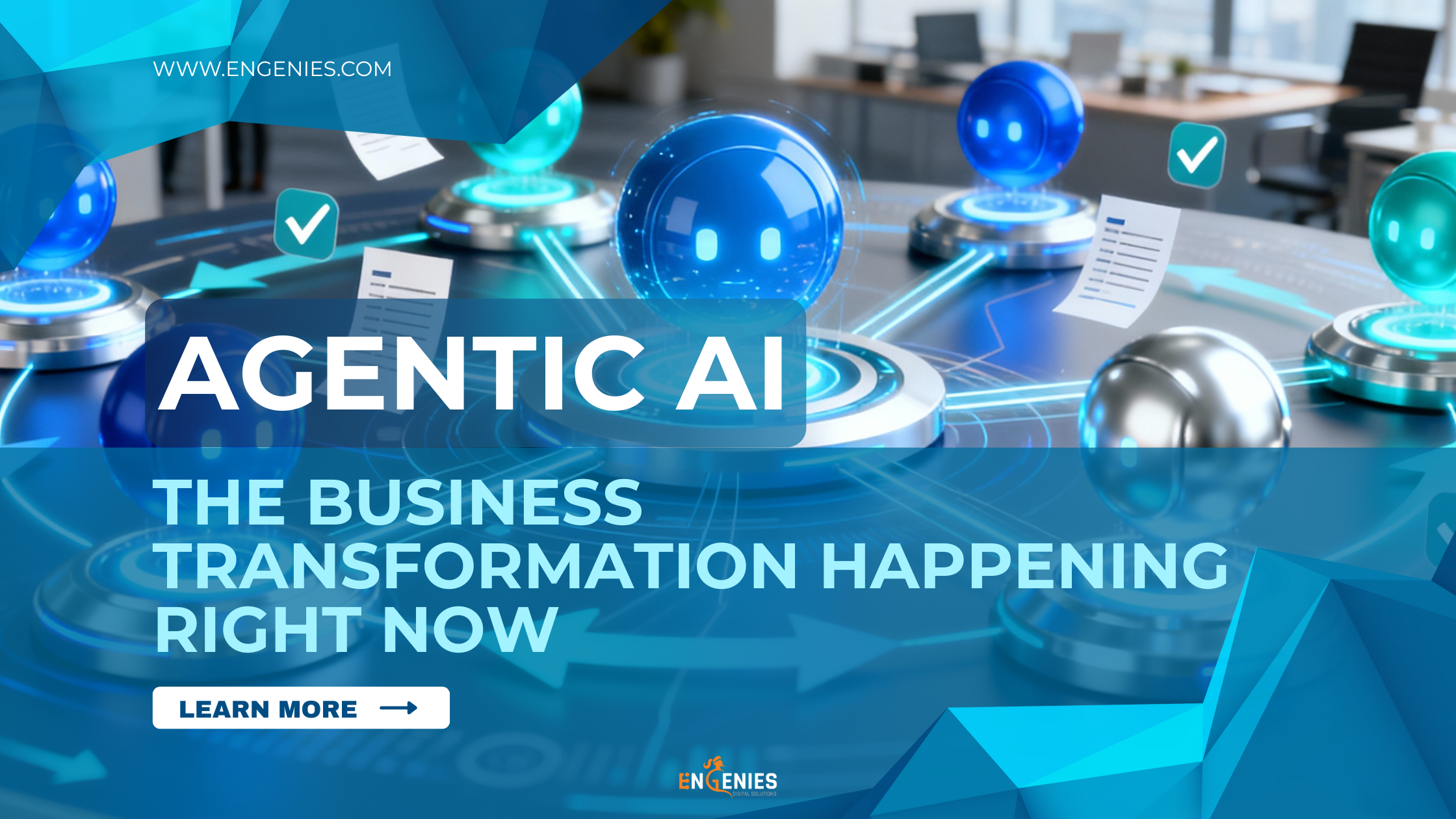
The Switch
While most organizations still debate whether to explore Agentic AI, early adopters are experiencing 1200%+ ROI and solving problems that were previously impossible. This isn’t theoretical anymore… it’s happening across healthcare, finance, manufacturing, and software development right now.
The real question isn’t whether to adopt Agentic AI. It’s whether you can afford to wait.
What’s Different
Traditional AI (i.E., ChatGPT): Generates text when prompted. Requires human interpretation. Stops after delivering output.
Agentic AI: Plans autonomously. Uses tools independently. Makes decisions without permission. Executes end-to-end workflows. Adapts and improves in real-time.
Concrete example: An insurance claims agent extracts data, verifies details against policy databases, flags inconsistencies, routes to departments, and approves or denies claims—often without human review. A process that took days now takes minutes.
Where It’s Winning Today
The Trends Reshaping 2025

Multi-Agent Ecosystems
Organizations deploy coordinated agents: sales agents negotiate, data agents pull insights, finance agents evaluate ROI, operations agents execute. All communicate without human handoffs.

Vertical-Specific Agents
Generic AI is giving way to domain-trained agents. Insurance agents understand claims. Healthcare agents understand clinical workflows. This specialization accelerates adoption dramatically.

Agent Marketplaces
Platforms like Hugging Face and Microsoft Copilot Studio offer plug-and-play solutions. Organizations can deploy pre-built agents for HR, Finance, Marketing in weeks instead of months.

Autonomous Decision-Making
As Standard
E-commerce agents adjust prices in real-time. Healthcare agents schedule treatments. Finance agents execute trades. The shift from “AI recommends” to “AI decides” is accelerating because it eliminates bottlenecks.

Human-in-the-Loop Governance

Responsible AI Advantage
EU AI Act compliance, bias detection, transparency requirements, and accountability frameworks are no longer optional. Organizations implementing these upfront avoid future rework and build customer trust.
Why 90% of Implementations Fail
Common mistakes:
- Treating deployment like software installation (agents need continuous refinement)
- No clear success metrics (only 45% of executives can quantify AI ROI)
- Ignoring edge cases (proof-of-concept works; production fails)
- Insufficient governance (agents drift from organizational objectives)
- Poor data quality (amplifies garbage-in problems)
The successful 10% do this:
- Pilot Selection – High-impact workflows with clear ROI and manageable complexity
- Training & Customization – Treat like employee onboarding; establish feedback loops; benchmark against human performance
- Integration – Connect to existing systems; ensure data quality; address bias upfront
- Supervised Deployment – Monitor for drift; update data continuously; fine-tune based on performance
- Scaling – Establish governance; build transparency; create center of excellence
Timeline: 6-12 months to profitability. Payback periods as short as 1.4 months in software development.
Industries Winning Fastest
What You’re Missing
If your organization hasn’t started exploring agentic AI, you likely lack:
- Autonomous decision-making – Still treating AI as advisory rather than decision-maker
- End-to-end automation – Automating isolated tasks vs. orchestrating complete processes
- Real-time adaptability – Using static rules vs. learning systems
- Multi-agent coordination – Separate systems vs. coordinated agents
- Measurable ROI – Unable to quantify AI business impact
- Governance frameworks – No boundaries around agent autonomy or oversight
- Domain-specific solutions – Horizontal tools vs. vertical solutions for your industry
The Next 18 Months
- Multi-agent orchestration becomes standard
- Enterprise AI platforms emerge as infrastructure
- Vertical-specific agents proliferate
- EU AI Act compliance mandatory
- Agent marketplaces reach critical mass
- 40% of enterprise workflows include agentic components
- Industry playbooks become standard
- Governance frameworks mature
- Agentic AI moves to business-critical systems
- Hybrid human-agent teams become operational standard
- Organizations unable to adopt fall behind competitively
- Business model transformation accelerates for early adopters
How to Start?
- Pick one problem – High-impact workflow with clear metrics
- Map your workflow – Document steps, decision points, handoffs
- Define success metrics – Current process time, cost, error rates
- Explore vertical solutions – Industry-specific agents rather than building from scratch
- Start with a pilot – Deploy under supervision; measure; refine
- Build governance first – Decision boundaries, oversight, escalation rules
The Bottom Line
Agentic AI is delivering 1200%+ ROI to early adopters in 2026, not 2030. The companies winning aren’t necessarily the most technologically advanced—they’re the ones who:
- Chose high-impact problems
- Implemented proper governance
- Measured rigorously
- Treated deployment as ongoing process
- Built coordinated multi-agent ecosystems
Your organization likely has multiple 20-30% efficiency opportunities in the next 12 months.
Will you identify and execute them, or will your competitors?
The window for early-adopter advantage is closing. But it hasn’t closed yet..,